Collaboration between practice and science to solve tomorrow’s questions
What do buildings and cities look like that contribute to health, sustainability, and social cohesion in the 21st century? This question is the guiding theme of the Jaap Oosterhoff Visiting Professor program, an initiative of TU Delft and Quake. Whether you are a researcher, student, designer, policymaker, or engaged professional: this program offers a platform where technology, creativity, and vision converge. Here you will meet international experts, learn from their insights, and contribute to solutions that truly improve the built environment.
What is the Jaap Oosterhoff Visiting Professor program?
The program is an initiative of the Architectural Engineering & Technology (AE&T) department at TU Delft, in collaboration with Oosterhoff and the innovation think tank Quake. Each year, an international expert is invited to give guest lectures, workshops, and public presentations within the Building Technology master’s track. The themes are current and urgent: from circular construction to digital innovation and nature-inclusive design. The chair is led by Ulrich Knaack (TU Delft) and Jaap Wiedenhoff (Quake). Together, they ensure an inspiring interaction between academia and practice.
“Gather the best specialists and generalists”
The program is named after Jaap Oosterhoff, who founded his own engineering firm in Arnhem in 1953 – the beginning of what later became ABT and Oosterhoff. His vision was progressive: building a society in which people live in harmony with their environment. This idea still forms the core of the program.
As Jaap Wiedenhoff puts it:
“To answer the complex issues of today and the future, we need more. Gather the best specialists and generalists. Let go of standards. Ask the right questions. Only then can we create a society in which people can flourish.”
Carlo Ratti: Technology as an Extension of the City
The program’s first visiting professor was Carlo Ratti, architect, engineer, and director of the MIT Senseable City Lab. Ratti researches how digital technologies are changing the way we understand, design, and experience cities. During his visit to TU Delft, he demonstrated how data and interaction can help make cities more responsive and people-focused. His message: technology should not direct, but support—as an extension of the city and its residents. Watch his lecture here. (foto credits: Andrea Avezzù)

Gert-Jan Rozemeijer: Timber Construction, What’s Next?
The second visiting professor is Gert-Jan Rozemeijer, director of Consultancy Lüning and specialist in timber construction. From November 2025 to February 2026, he gave various lectures at TU Delft. He sees building with timber as an opportunity to link sustainability with aesthetics and health. In his contribution to the program, he will explore, together with students and researchers, how timber construction can be further scaled up. His enthusiasm is infectious:
“It’s wonderful to see that building with wood is rapidly gaining ground. At the same time, more is needed to further scale up timber construction. To maximize the benefits in terms of sustainability and health, there is a need for a different design approach, technical innovations, and a new design language for wooden buildings.”

Technology with Understanding
The program uses technology to create open, healthy, nature-inclusive, and climate-adaptive spaces. Think low CO₂ emissions, high energy efficiency, and circularity. But it goes beyond technology: it’s about understanding, not control. How can we use technology to restore the connection with nature, society, and the climate?
Tosin Oshinowo: designing witch gentle modernity
Starting 18 February, architect, designer and entrepreneur Tosin Oshinowo will succeed Gert‑Jan Rozemeijer as the next Oosterhoff Visiting Professor. Based in Lagos, Tosin brings a globally relevant perspective that aligns closely with Quake’s mission to help shape a built environment that is resilient, inclusive, and future‑proof. Her experience designing in one of the world’s fastest‑growing cities has shaped a design philosophy built on creativity through constraints—demonstrating how limitations can spark innovation and new architectural thinking.
At TU Delft, she will encourage students to adopt this mindset: embracing boundaries as catalysts for creativity, responsibility, and societal ambition.
Tosin’s work is guided by the concept of gentle modernity: an approach that rejects extractive consumerism and instead embraces adaptability, context, and care. Her research on Lagos’ self‑organising marketplaces highlights how local systems can create resilient urban structures—and how architecture can support rather than override them.

Building physics in the spotlight with Ad van der Aa and Veronika Heidegger
Building physicists Veronika Heidegger and Ad van der Aa are the Jaap Oosterhoff Visiting Professors at TU Delft for the autumn of 2026. With their shared expertise, the specialists from ABT want to show students and researchers how building physics can contribute to the major challenges of our time, from climate change and health to sustainability and digitalization. Their central message: building physics is not primarily about complying with rules and labels, but about understanding, predicting, and realizing the actual performance of buildings.”
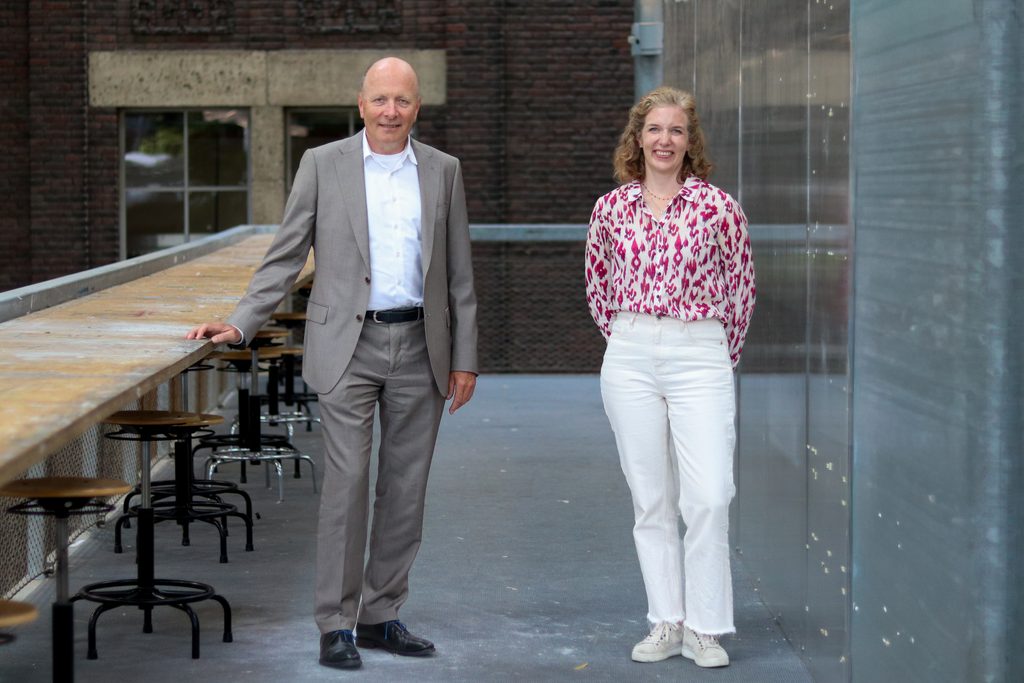 © TU Delft – Bart Haagsma
Get Involved
The Jaap Oosterhoff Visiting Professor program isn’t a one-way street. It invites you to contribute your ideas, learn, and build a future-proof living environment. Together, we create a platform where expertise, creativity, and social engagement converge.
You can watch the lectures on the TU Delft AE&T YouTube account.
